A repeatable remote quoting process for cleaning companies: the intake questions that predict minutes, the photo and video you should ask for, how to quote a range, and how to confirm on arrival without renegotiating.
Why deep cleans and move-out cleans cost far more than a routine visit, how to build both prices from measured minutes, and the scope items that must be priced separately.
A practical Google Business Profile setup for cleaning companies: categories, service areas, photos, questions, review flow, and the parts of local ranking nobody outside Google can measure for you.
The practical difference between a W-2 cleaner and a 1099 contractor for a small cleaning business: control, cost, insurance, scheduling reliability, and the numbers to model before you hire.
What an hour of residential cleaning actually includes, a planning table for time per house size, and a repeatable formula for converting hours into a flat quote customers will accept.
A cleaning route is a sequence decision, not a map. Here is how to cluster jobs by area, order them by drive time, protect callbacks, and measure whether the route is actually denser than last month.
Recurring cleaning is cheaper to deliver per visit than one-time work, but only if the discount is calculated from real minutes. Here is the arithmetic, the guardrails, and the churn math that decides whether a recurring plan pays.
Where AI pays off first for small service-business owners — phone coverage, follow-up, inbox, and ops — without a tech team or another chatbot listicle.
Missed mid-job and after-hours calls cost small businesses real leads. See what an AI phone does vs hiring a receptionist — and why booking requests beat silent calendar writes.
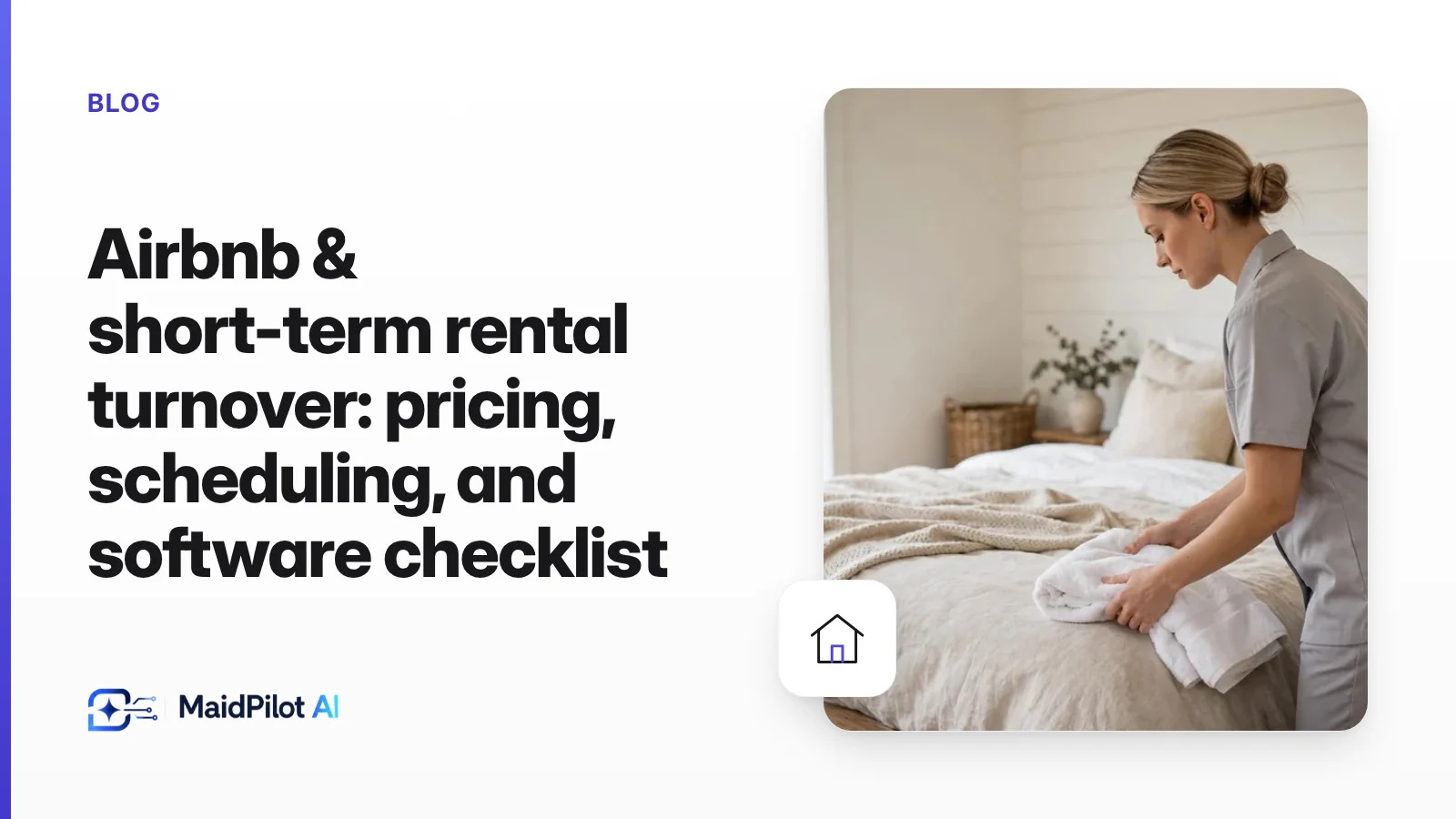
Turnover cleans run on a tighter clock and a higher-stakes checklist than standard residential work. Here's how to price them, schedule around same-day guest changeovers, and avoid the review-tanking mistakes.
What general liability, workers' comp, and bonding actually cover for a cleaning company — and why "bonded and insured" is a trust signal clients are quietly checking for.
Reviews decide who gets picked when a homeowner searches for a cleaner near them. Here's a simple, repeatable process for asking — and what to do when a review isn't perfect.
A practical hiring checklist for cleaning businesses — where to find candidates, what to screen for, and how to structure a trial run before someone is alone in a client's home.
What a modern AI phone receptionist actually does for cleaning companies — lead capture, booking requests, summaries, and safe handoff — without sounding like a robot phone tree.
What to charge for house cleaning: a time-per-house-size table, the extras that belong on a separate line, frequency discounts, and the formula that turns your loaded cost into a flat quote.
A step-by-step cleaning quote template — scope, inclusions, timeline, and follow-up — so homeowners and property managers say yes without endless emails.
A spreadsheet works fine for one crew and a handful of clients. Here are the specific signs it's starting to cost you jobs, hours, and clients — and what to look for instead.
Recurring and one-time cleaning jobs pull a business in different directions. Here's how to weigh acquisition cost, lifetime value, and crew scheduling when deciding where to spend your marketing dollars.